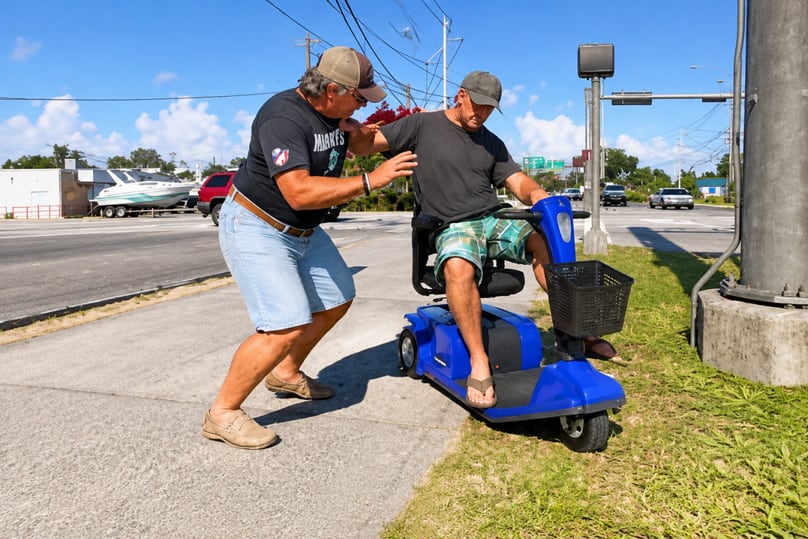
An argument beside a parked vehicle can be background activity, a response to your actions, or the beginning of an encounter you can influence. Exploring GTA 6 means learning to tell those situations apart without treating every raised voice as a mission invitation.
Players researching GTA 6 Boosting may be looking for faster progression, but NPC encounters require a different kind of attention. Read the available action, listen to the response, and check what actually changes. An unusual conversation does not establish a reward, unlock condition, or repeatable money-making method.
Starting a Conversation Without Starting a Fight
Check your weapon before approaching
In observed PS5 gameplay, approaching an ordinary pedestrian unarmed and holding L2 displays a character label and interaction options. The tested pedestrians offered Greet on Cross and Taunt on Square. With a firearm drawn, L2 instead functions as aiming, so putting the weapon away changes how you approach the situation. Use your displayed controls if your platform or configuration differs.
For a straightforward conversation attempt:
- 1. Stop somewhere you can read the interface without obstructing traffic.
- 2. Put your weapon away.
- 3. Approach the person and check the available action.
- 4. Select a greeting if your aim is to observe a neutral exchange.
- 5. Let the response finish before selecting another input.
Treat this as an observation routine, not a hidden unlock sequence.
Look for a change in the action label
The interaction menu can reflect the situation. During an observed protest blocking a truck, both a protester and the driver offered Question, rather than the ordinary pedestrian greeting options. That provides a concrete reason to investigate the scene instead of assuming the crowd is decorative.
Read the verb before pressing the button. A familiar input does not necessarily perform the same action with every character.
Background Behaviour or an Encounter You Can Influence?
Use the distinction below as a practical inspection checklist. It is not a complete catalogue of the game’s internal event categories.
| What you notice | What it establishes | What to investigate |
| People speaking to one another | A conversation is taking place | Whether anyone addresses you or offers an action |
| A pedestrian answers your greeting | You have received a social response | Whether another option becomes available |
| Someone reacts after you hit their vehicle | Your action has caused a reaction | Whether there is anything to do beyond the confrontation |
| A person offers a situation-specific prompt | The game provides an explicit interaction | What that action asks you to choose |
| An unusual scene contains an accessible object | There may be an environmental interaction | Whether the object has a supported action |
| A scene ends without an objective | You witnessed an exchange | Whether anything changed, rather than assuming a missing mission |
Keep reactions, interactions, and objectives separate in your notes. “The driver shouted at me” describes a reaction. “A new action appeared” describes an interaction opportunity. Neither statement proves that a mission has started.
How Context Changes an NPC Encounter
Ordinary pedestrians: establish a neutral comparison
If you want to investigate conversation behaviour, avoid combining several actions in one attempt. Greeting someone after colliding with them does not give you a clean example of a neutral greeting.
A useful record includes:
- The protagonist you controlled.
- The action shown on screen.
- Whether you had a weapon drawn.
- What you did immediately before the exchange.
- Whether a follow-up action or objective appeared.
These details make your observations easier to interpret. One hostile response is not enough evidence to classify an entire area as hostile.
Threats: do not assume every response works universally
One observed encounter involved a stranger attempting to rob Lucia. Selecting a taunt caused the attacker to abandon the attempt and flee. That establishes a possible outcome in that encounter, not a guaranteed solution to every robbery.
If you are investigating dialogue outcomes, inspect the available responses before acting. Choosing combat immediately prevents you from observing what a conversational response would have produced.
Vehicle disputes: distinguish discovery from provocation
Before calling a roadside confrontation a random event, ask a simple question: Was it already happening when you arrived?
For your own exploration notes, separate these circumstances:
- You arrived while other characters were already involved in a dispute.
- A driver reacted after you interfered with their vehicle.
- A specific prompt invited you to participate.
This distinction helps avoid presenting an ordinary consequence of your actions as a special encounter trigger.
Environmental Clues Can Lead Beyond Conversation
Watch where an incident leads
An observed aircraft crash could be investigated by following its smoke trail. The crash site contained collectible contraband. This is an example of environmental observation leading to accessible content without beginning with a conversation. It does not establish that every smoke trail or damaged aircraft produces the same encounter.
When something unusual catches your attention:
- 1. Find a safe place to stop.
- 2. Identify where the disturbance is coming from.
- 3. Approach closely enough to inspect it.
- 4. Check both nearby people and objects for supported actions.
- 5. Record the result without adding an assumed reward or follow-up.
Avoid judging the entire scene from the first person you meet. Your inspection should include the surroundings, not just dialogue.
Revisit an unresolved location with a specific question
Some hidden content appears during return visits or at night, while some locations develop across visits separated by in-game days. These are different discovery conditions, not a universal timer that applies everywhere.
Why an Encounter May Not Return
Encounter tracking distinguishes between briefly passing a scene, partially observing it, and actively participating. Those levels of engagement can affect whether it returns. Some distinctive encounters are treated as non-repeatable after a sighting, while certain characters can appear again with different dialogue or interactions.
For exploration, use two precautions:
- Stop for an encounter you genuinely want to investigate. Do not assume it will return unchanged.
- Do not treat repeated driving around the block as a confirmed reset method. Without a verified condition, you are testing a possibility.
Meeting a character again also does not prove that their earlier encounter has reset. Record the new interaction separately.
Build an Exploration Record You Can Trust
Keep a compact log instead of collecting vague claims about secrets:
| Field | What to record |
| Location | A recognisable landmark or map position |
| Circumstances | Protagonist, approximate time, and what was happening on arrival |
| Available action | The wording displayed by the game |
| Player choice | The response or action you selected |
| Observed result | Dialogue, movement, an accessible object, or an objective change |
| Unresolved question | Something to test on a later visit |
Commercial searches such as cheap GTA 6 Boosting should remain separate from that record. A sales description is not evidence that a particular NPC conversation, environmental discovery, or encounter can be unlocked on demand.
Write down “I chose this response and the stranger left,” rather than “this response always makes strangers leave.” Before departing an unusual scene, check for a changed prompt, an object you can interact with, or a new objective. If none appears, record the exchange as observed instead of inventing an unfinished task.